Introduction: Indians Aren’t Just Scrolling Anymore — They’re Shopping
Open Instagram right now. What do you see?
Reels of products. Stories with “swipe up to buy.” Influencers showing unboxing videos. A DM notification from a brand you follow asking if you want to place an order.
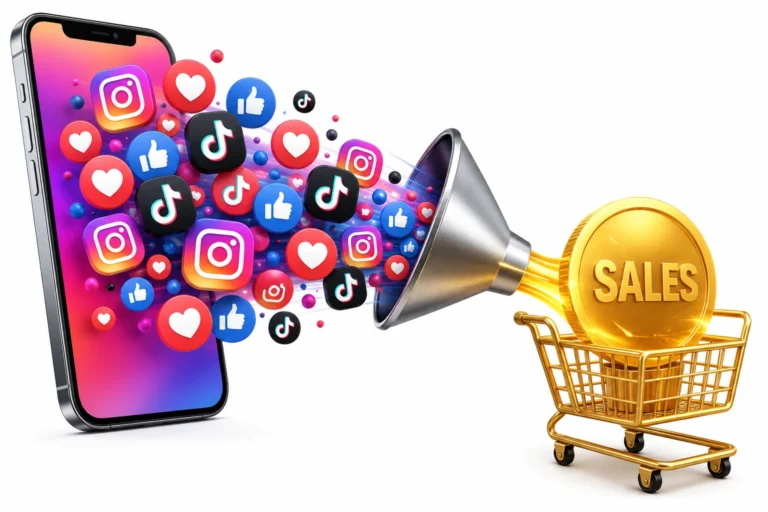
This is social commerce — and in India in 2026, it is not a trend. It is the mainstream way millions of people discover, evaluate, and buy products.
India crossed 700 million social media users in early 2026, making it the single largest addressable social audience outside China. And a fast-growing share of those users are not just passively scrolling — they are shopping directly inside the apps where they spend their time.
What started as a discovery channel has now become a full-fledged sales ecosystem. Today, customers can explore products, interact with brands, and complete purchases all within the same app.
For D2C brands, local businesses, service providers, and e-commerce sellers across India, this shift represents an enormous, largely untapped opportunity. The question is: are you building the right social commerce strategy to capture it?
At JashMarketing, our Social Media Marketing team works with Indian brands every day to build exactly this kind of revenue-generating social presence. Here is everything you need to know — from platform breakdowns to a step-by-step action plan.
H2: What Is Social Commerce and Why Does It Matter in India?
Social commerce means selling products or services directly through social media platforms — from discovery all the way to payment — without the customer ever needing to leave the app or visit a separate website.
No expensive website needed. No complicated checkout. Just great content, a product catalog, and a Buy button.
India is uniquely suited for social commerce because of three factors that do not exist to the same degree anywhere else in the world:
- Affordable smartphones and cheap mobile data — India has the world’s lowest average mobile data cost, putting social media in the hands of every economic segment
- WhatsApp’s dominance as a trusted communication channel — Indians already conduct personal conversations, family group chats, and business discussions on WhatsApp, making it a natural commerce bridge
- Strong preference for chat-based and relationship-mediated buying — especially in Tier 2 and Tier 3 cities, Indian consumers prefer talking before buying
Social commerce in India is less about Instagram’s checkout button and more about relationship-mediated selling — a brand’s WhatsApp group, a local influencer’s recommendation, a YouTube review that drives someone to DM for purchase.
This makes the Indian social commerce playbook very different from what works in Western markets — and it is exactly why a generic, copy-paste strategy will not work here.
H2: The 3 Platforms Driving Social Commerce in India Right Now
Instagram — The Discovery and Impulse Purchase Engine
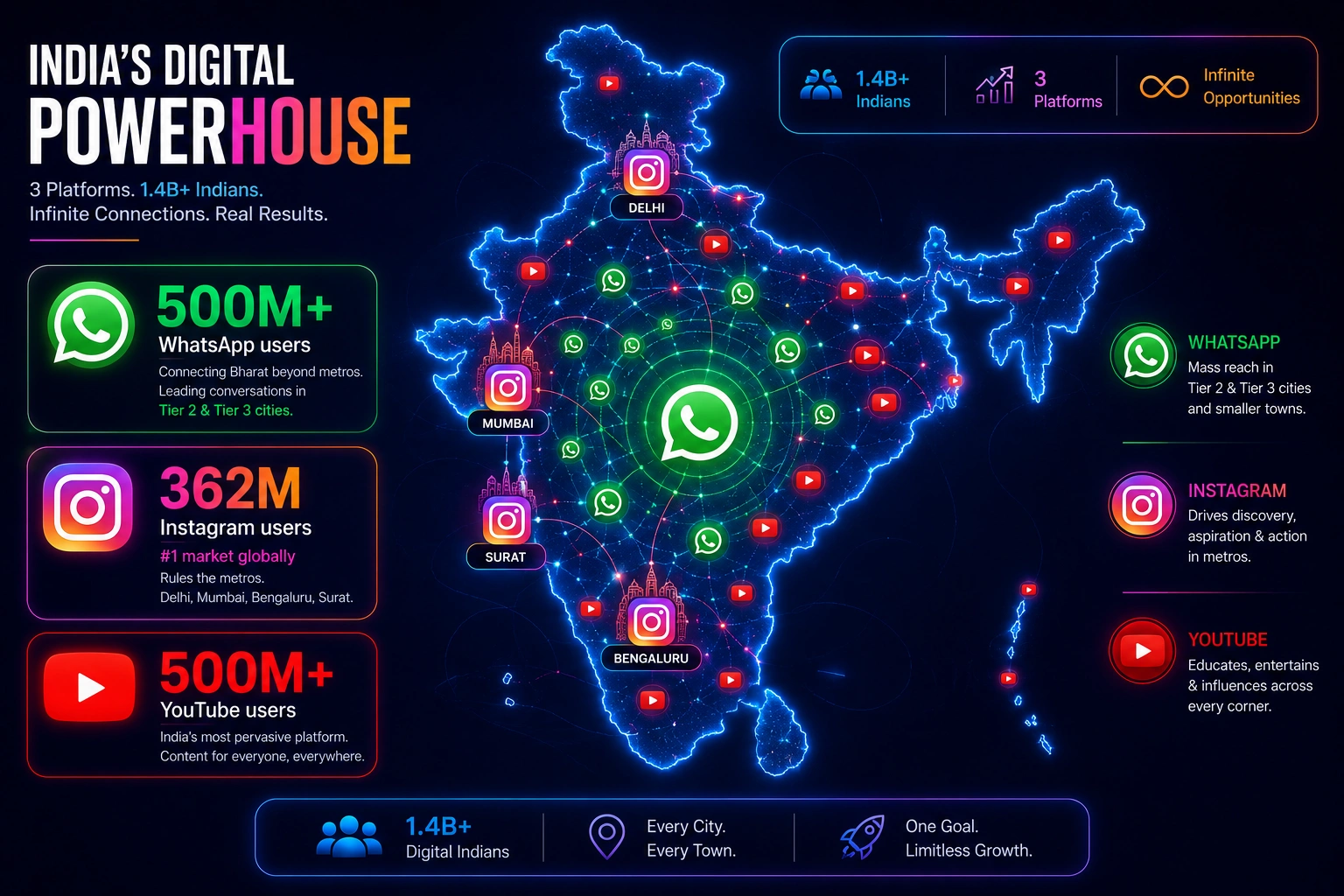
India now accounts for 362 million Instagram users, surpassing the US as the largest single market. This is not a statistic to gloss over — it means there is more Instagram audience available in India than anywhere else on Earth.
The platform’s evolution into a commerce channel has been dramatic:
- Instagram Shopping drives $37.7 billion in annual commerce globally in 2026, with native checkout conversion rates of 3.1% for optimized storefronts.
- Businesses with Instagram Shops generate 44% more revenue from the platform than those without.
- Reels generate 67% higher engagement than static feed posts, with completion rates for Reels under 30 seconds exceeding 72%.
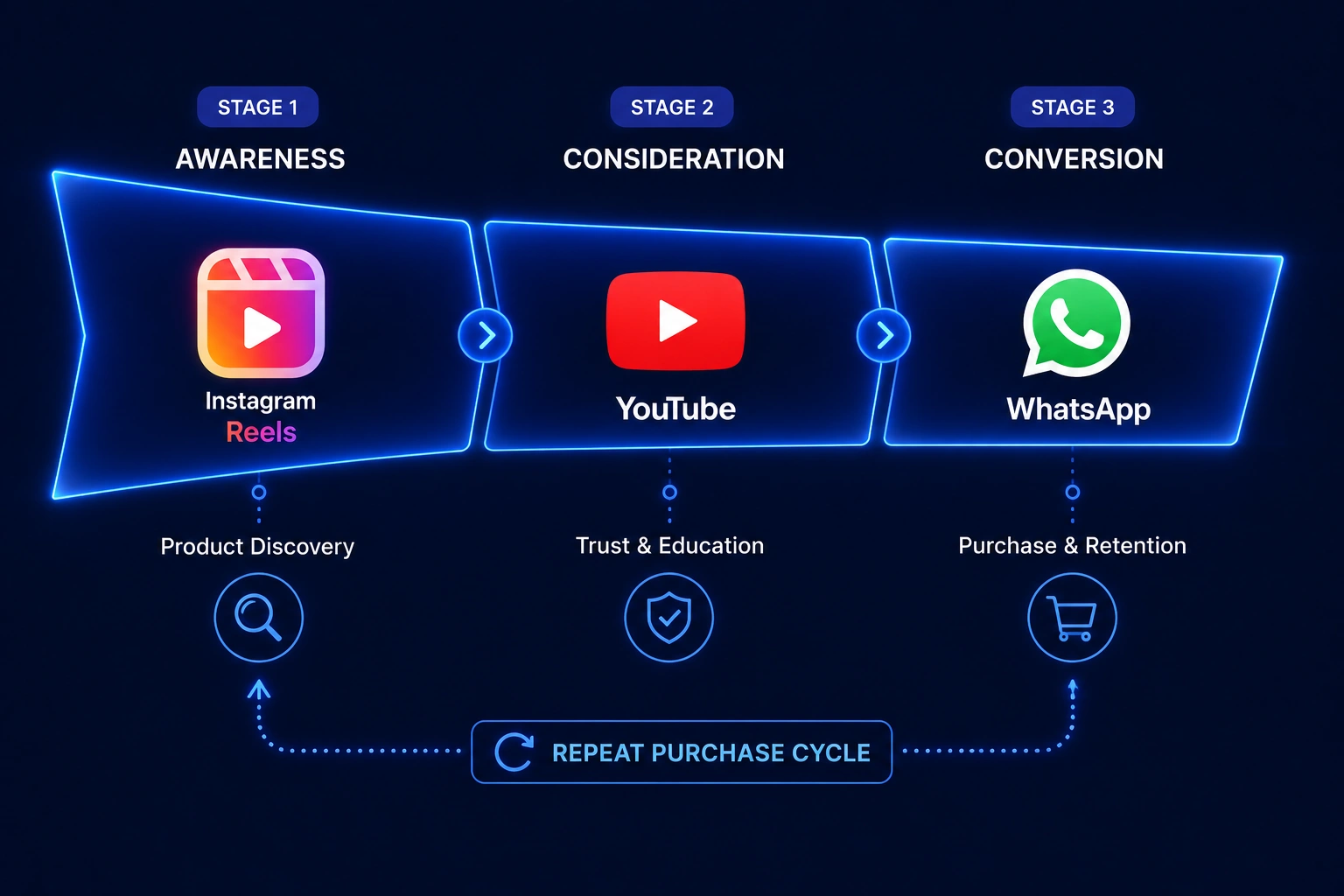
The Instagram commerce funnel in India works like this: Reels discovery → Profile visit → Product tag click → DM or WhatsApp for purchase.
Instagram Shopping is most effective for fashion, beauty, home décor, and food — any product that is visually compelling and purchased impulsively.
If your business sells anything visual, Instagram is not optional in 2026 — it is your primary storefront.
Our Social Media Marketing service includes full Instagram Shop setup, Reels content strategy, and product-tagging campaigns tailored specifically for Indian brands.
WhatsApp — The Conversion and Retention Powerhouse
WhatsApp’s conversion rate for social commerce in India is 2–4x higher than Instagram or Facebook. The reasons are deeply rooted in Indian consumer behavior: personal trust, ease of purchase via catalogue + payment link in one conversation, and reach into demographics that do not actively use Instagram.
Key WhatsApp commerce tools every Indian business should be using:
- WhatsApp Business Catalogue — showcase your products or services directly in the app
- Broadcast Lists — send personalised product announcements to opted-in customers (up to 256 contacts)
- WhatsApp Communities — WhatsApp Communities (up to 1,000 members) work well for loyal customer communities where you share exclusive offers, product previews, and behind-the-scenes content.
- WhatsApp Business API — for brands with larger customer bases, enables automated catalogue sharing, order confirmation, and tracking
The numbers back this up clearly: WhatsApp-driven repeat purchase rates for D2C beauty and food brands are 2.4x higher than email-driven repeat. Cart recovery via WhatsApp is converting at 9–14% versus 1–2% via email.
WhatsApp has the highest open rate of any digital channel (95%+). Use it for order updates, appointment reminders, and re-engagement campaigns.
YouTube — The Long-Form Trust Builder
India has 500M+ monthly active YouTube users, making it the largest video platform in the country. While Instagram drives impulse purchases, YouTube drives considered purchases — products that require explanation, demonstration, or comparison.
The winning playbook for Indian brands: WhatsApp for community and conversion, Instagram for discovery, YouTube for education and consideration.
For service businesses like digital agencies, consultants, and B2B companies, YouTube content builds the kind of sustained trust that social commerce for products achieves through influencers. A well-produced “How we helped [client] achieve [result]” video on YouTube is the B2B equivalent of an Instagram product Reel.
H2: The Reels-First Strategy — Why Short Video Is Non-Negotiable in 2026
If there is one single tactical shift that will have the biggest impact on your social commerce results in 2026, it is this: go Reels-first.
Reels CPMs in India are 35% cheaper than feed-post CPMs in 2026 because Meta is still pushing inventory. You are getting more reach for less money — but only if you produce Reels consistently.
Instagram’s algorithm in 2026 heavily favors Reels. Data shows Reels generate 4.2x more reach than static feed posts and 2.8x more engagement than Stories for the same ad spend.
Short-form video drives over 70% of all social commerce sales in 2026. Videos under 15 seconds perform best for discovery; videos between 30–60 seconds work best for product demonstrations and consideration.
What Makes a High-Converting Reel in India?
Hook in the first 2 seconds. Post 4 to 5 Reels per week with strong hooks in the first 2 seconds, relevant hashtags, and a clear call to action. The algorithm rewards watch time — if you do not hook the viewer immediately, they scroll and your reach collapses.
Native-feeling content, not polished ads. The most successful Instagram campaigns feel native to the platform — authentic, entertaining, and valuable first, promotional second. A smartphone-shot demo video showing a real customer using a product consistently outperforms a ₹50,000 studio production.
Social SEO in your captions. Social SEO is the practice of optimising your social media content to appear in search results within the app. Young consumers often search for things like “best skincare for oily skin” on Instagram or YouTube instead of Google. Use natural, conversational language a buyer would use — for example, “best budget gaming mouse India” or “trending lehenga designs 2026.”
Tag products in every relevant Reel. Every Reel showing your product should have a product tag linked to your Instagram Shop or your website. This turns passive viewers into active shoppers with one tap.
Need help building a consistent Reels content pipeline? Our Content Engine service handles scripting, production strategy, publishing calendars, and performance tracking — so you never run out of content that converts.
H2: The Micro-Influencer Advantage — Why Small Beats Big in India
One of the most consistent findings in Indian social commerce research for 2026 is this: micro-influencers deliver better ROI than macro-influencers for most brands.
Brands partnering with 50–100 micro-influencers (5K–100K followers) in their niche consistently outperform macro-influencer partnerships on ROI. Micro-influencers have higher engagement rates, stronger community trust, and lower CPM. Ten micro-influencer partnerships often outperform one macro-influencer partnership at the same cost.
User-generated content (UGC) and creator collaborations drive higher trust and conversion than traditional ads. This is especially true in India where audiences are increasingly skeptical of obviously paid celebrity endorsements but deeply trust recommendations from creators who feel like “people like me.”
How to Build a Micro-Influencer Programme for Your Brand
| Step | Action |
|---|---|
| 1. Define your niche | Fashion, food, home, tech, finance — stay category-specific |
| 2. Find creators | Instagram search, Meta Creator Marketplace, or manual search by hashtag |
| 3. Filter by engagement rate | Look for 3–8% ER, not just follower count |
| 4. Prioritize regional language creators | Hindi, Gujarati, Tamil, etc. creators have deeply loyal Tier 2/3 audiences |
| 5. Brief properly | Key message + product benefit + CTA — but give creative freedom |
| 6. Reuse the content | Best-performing influencer videos become your paid ad creative |
| 7. Track & optimize | UTM links, promo codes, or WhatsApp DM tracking per creator |
H2: Social Commerce Strategy for Indian Service Businesses
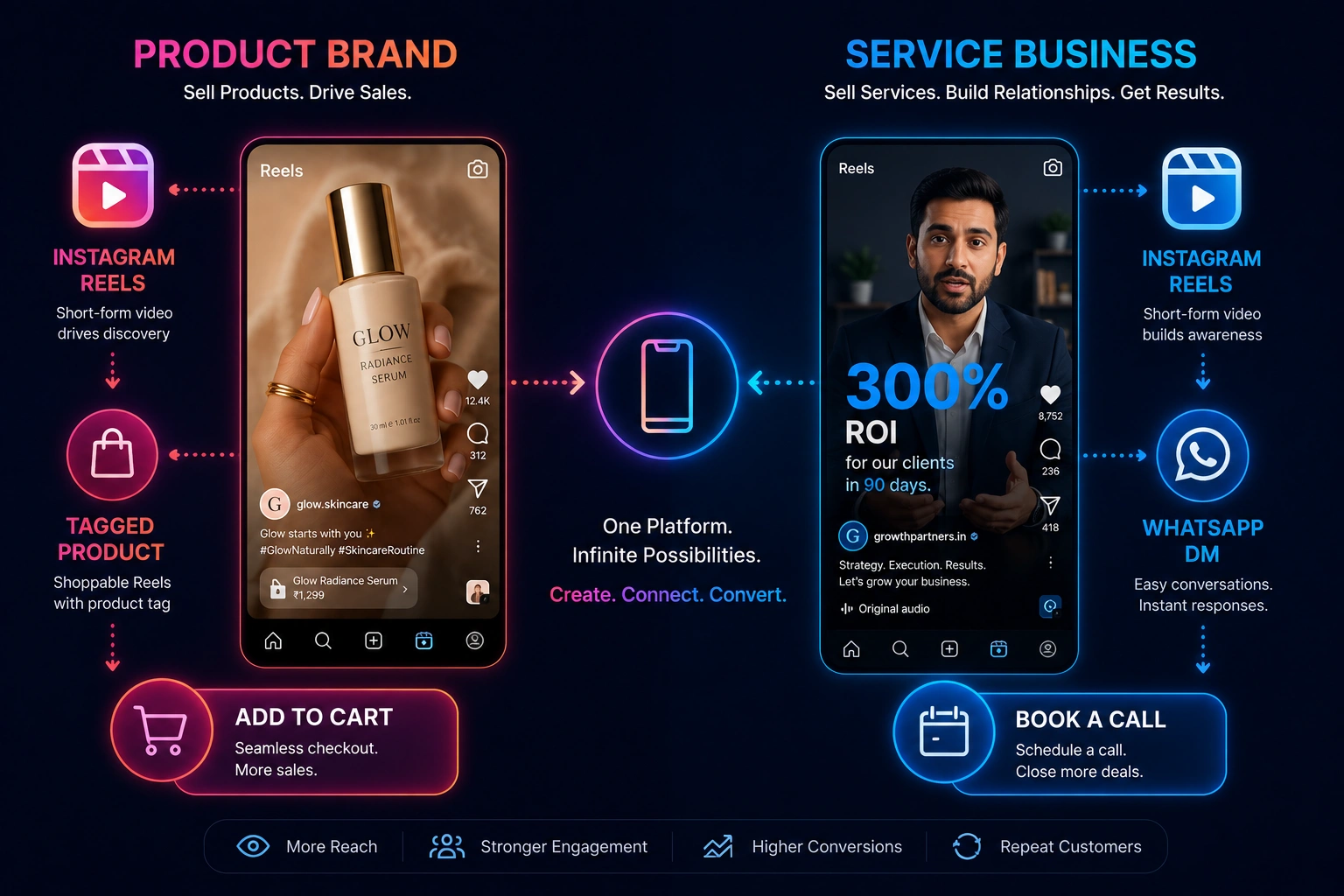
Most social commerce guides focus on product brands — fashion, beauty, food, gadgets. But service businesses — digital agencies, consultants, real estate firms, healthcare providers, education companies — can and should be running social commerce strategies too.
Here is how service businesses can adapt the social commerce playbook:
Instagram for Lead Generation, Not Just Product Sales
- Post Reels showing results: before/after case studies, client testimonials, process explainers
- Use lead-generation ads with WhatsApp CTA buttons
- Run Stories polls and Q&A stickers to identify pain points and segment your audience
WhatsApp as Your Sales Channel
- Share case studies and service packages via WhatsApp catalogues
- Use broadcast lists to announce new service offerings or limited-time pricing
- Set up automated WhatsApp workflows for inquiry → consultation booking
YouTube for Authority Building
- Publish “how-to” and “behind the scenes” content that demonstrates expertise
- Address your ideal client’s top 10 questions in a video series
- Link your videos to your services page in every description
At JashMarketing, our Social Media Marketing service is specifically built to help both product and service businesses build social commerce systems that generate qualified leads and repeat business. You can also explore our Pricing page to understand which package fits your scale.
H2: Social Commerce Metrics That Actually Matter
Too many Indian businesses track vanity metrics — likes, follower counts, story views. Here are the metrics that directly connect to revenue:
| Metric | What It Measures | Benchmark (India 2026) |
|---|---|---|
| Reels Reach Rate | % of followers who see your Reel | 20–40% for well-optimized accounts |
| Reels Completion Rate | % who watch to the end | Target 40%+ for under-30s Reels |
| DM Conversion Rate | DMs that turn into sales/leads | 5–15% for product brands |
| WhatsApp Cart Recovery Rate | Abandoned carts recovered via WhatsApp | 9–14% (vs 1–2% for email) |
| Cost Per Lead (CPL) via Meta Ads | ₹ spent per qualified inquiry | ₹50–₹300 for Indian SMBs |
| Micro-Influencer CPM | Cost per 1,000 impressions via creators | ₹200–₹800 depending on niche |
| WhatsApp Repeat Purchase Rate | % of WhatsApp customers who buy again | 2.4x higher than email baseline |
Indian businesses that invest consistently in social media marketing see 3x to 7x returns on ad spend when campaigns are well-optimised.
H2: Paid Social — When and How to Amplify With Meta Ads
Organic social commerce is powerful, but paid amplification dramatically accelerates results. Meta Ads (Facebook + Instagram) offer some of the most precise audience targeting available anywhere — by city, age, interests, behaviour, and even purchasing intent.
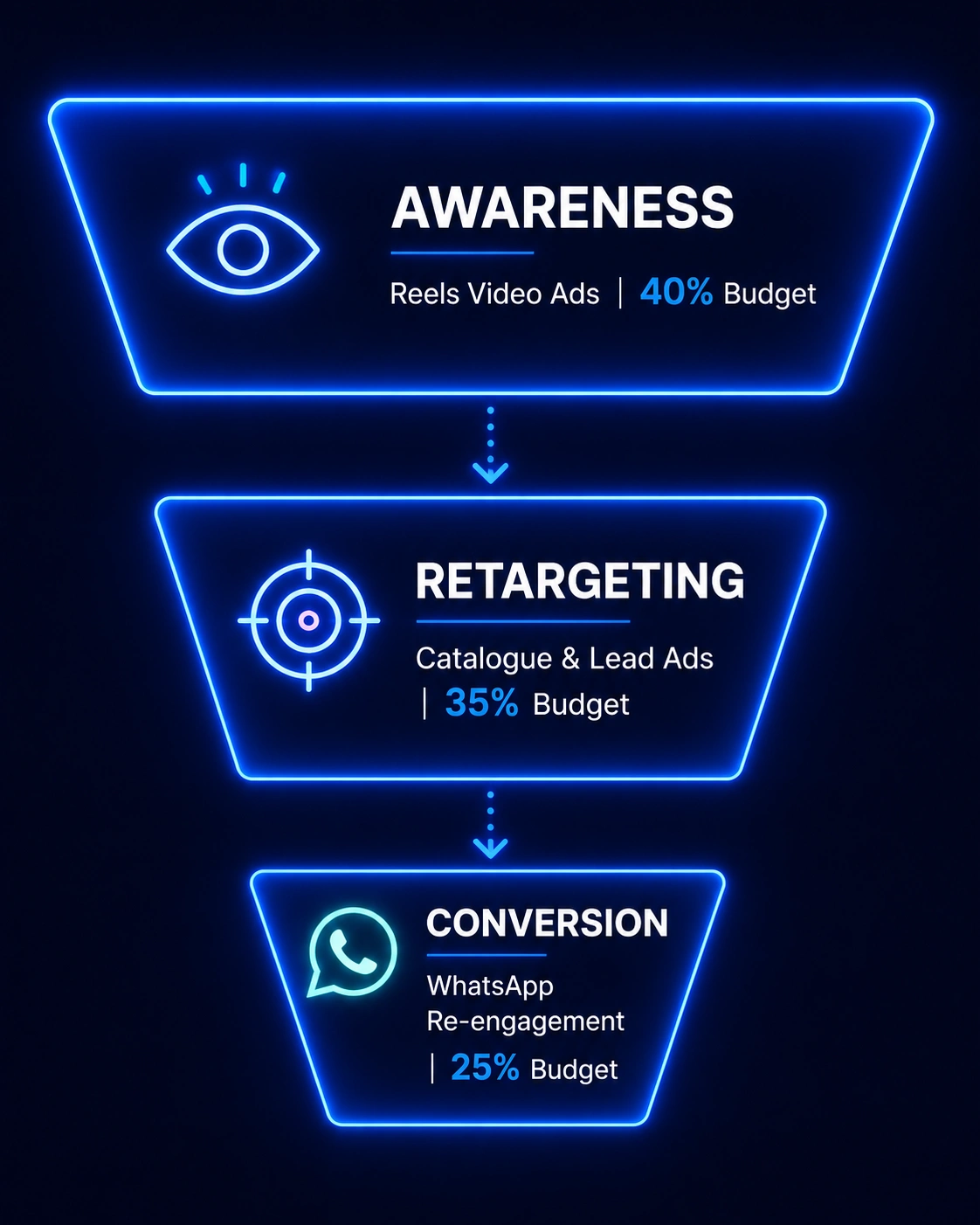
The winning Meta Ads funnel for Indian social commerce:
Stage 1 — Awareness: Run Reels video ads targeting cold audiences. Goal: views and profile visits. Budget: 40% of total ad spend.
Stage 2 — Retargeting: Retarget video viewers (25%+) and profile visitors with catalogue or lead ads. Goal: DMs, WhatsApp conversations, or website clicks. Budget: 35% of total ad spend.
Stage 3 — Conversion/Retention: Retarget website visitors and existing customers with WhatsApp re-engagement campaigns or exclusive offer ads. Goal: repeat purchase, upsell. Budget: 25% of total ad spend.
Our PPC & Paid Acquisition team builds and manages these full-funnel Meta campaigns for Indian businesses, ensuring every rupee of ad spend is tracked back to actual business results. You can review what we offer on our Services page or get specific costs from our Pricing page.
H2: Common Social Commerce Mistakes Indian Brands Make
❌ Mistake 1: Treating Instagram like a photo album Posting static images and expecting meaningful reach in 2026 is like printing a newspaper and wondering why no one is reading it. Reels are the algorithm’s priority. Shift now.
❌ Mistake 2: No WhatsApp commerce strategy Most Indian SMBs have a WhatsApp number but no systematic WhatsApp commerce workflow — no catalogue, no broadcast list, no cart recovery sequence. This is leaving enormous revenue on the table.
❌ Mistake 3: Chasing follower count over engagement A page with 500 highly engaged followers who DM and buy is worth infinitely more than a page with 50,000 passive followers who never interact. Focus on community quality.
❌ Mistake 4: Creating ads that look like ads The algorithm and users can spot paid content instantly. The most successful campaigns feel native to the platform — authentic, entertaining, and valuable first, promotional second.
❌ Mistake 5: Not using Social SEO in captions More than 40% of Gen Z and Millennials now discover products directly on social platforms instead of Google. If your captions are not keyword-optimized for in-app search, you are invisible to this growing segment.
❌ Mistake 6: Ignoring Tier 2/3 audiences India’s next 200 million internet users are coming from Tier 2 and Tier 3 cities. Regional language content, WhatsApp-first strategies, and local micro-influencers are the fastest-growing social commerce opportunity in the country.
H2: Frequently Asked Questions About Social Commerce in India
Q1: Do I need a website to start social commerce in India? No. You can start selling entirely through Instagram DMs, WhatsApp Business, and Facebook Shops without a website. However, as you scale, a well-designed website improves trust, conversions, and your ability to run retargeting ads. Our Web Development & Design service can build a high-converting site that integrates seamlessly with your social commerce setup when you are ready.
Q2: How many Reels should I post per week? Post 4 to 5 Reels per week with strong hooks in the first 2 seconds, relevant hashtags, and a clear call to action. Consistency matters more than perfection — a steady flow of authentic content beats occasional polished productions.
Q3: Is WhatsApp Business free? The basic WhatsApp Business app is free and sufficient for most small businesses. The WhatsApp Business API (for larger-scale automation, bulk messaging, and CRM integration) involves costs from platform partners like Wati, Interakt, or Zoko — typically ₹2,000–₹10,000/month depending on message volume.
Q4: Which is better for social commerce — Instagram or Facebook in India? Both serve different purposes. Instagram is superior for discovery and impulse purchase, especially for visual product categories and audiences under 35. Facebook is stronger for community groups, local service businesses, and audiences over 35. For most Indian brands, a combined strategy with Meta Ads Manager running across both platforms delivers the best results.
Q5: How do I track ROI from social commerce? Use unique UTM links for each platform and campaign, unique promo codes per influencer, WhatsApp conversation tagging, and Meta Ads conversion tracking (with Meta Pixel or Conversions API). Our PPC & Paid Ads team sets up complete attribution tracking for all social commerce campaigns.
Q6: Can social commerce work for B2B businesses? Yes — LinkedIn is the primary B2B social commerce platform globally, but in India, WhatsApp Business and Instagram (via DMs and lead ads) are also significant B2B lead generation channels, especially for SMB-to-SMB selling. Our about page explains how we have applied these strategies for B2B clients across Gujarat.
Q7: How much does it cost to run social commerce campaigns with a professional agency? A professional agency offering strategy, content creation, community management, and paid campaigns typically charges ₹25,000–₹1,00,000+ per month depending on the number of platforms and scope. Visit our Pricing page to see JashMarketing’s specific packages.
H2: Your 30-Day Social Commerce Quick-Start Plan
If you are starting from scratch or want to reset your social commerce strategy, here is a practical 30-day roadmap:
Week 1 — Foundation
- Set up or audit your Instagram Business Profile (bio, link, contact CTA)
- Set up WhatsApp Business with a catalogue of your top 5 products/services
- Install Meta Pixel on your website (if you have one)
Week 2 — Content
- Film 8–10 short Reels (30 seconds or under) showing your products/services in real use
- Write captions with Social SEO keywords (how people search for your category)
- Set up your first Instagram Shop with product tags
Week 3 — Audience Building
- Identify 5–10 micro-influencers in your niche (use Instagram search by hashtag)
- Reach out with a simple collaboration proposal
- Start a WhatsApp broadcast list with existing customers
Week 4 — Paid Amplification
- Run your first ₹5,000–₹10,000 Reels video awareness campaign on Meta Ads
- Set up a retargeting campaign for video viewers
- Launch a WhatsApp Click-to-Chat ad targeting your ideal customer profile
By Day 30, you will have a real social commerce foundation generating measurable leads, DMs, and sales.
Want us to build this for you end-to-end? Contact JashMarketing and let us put together a social commerce strategy tailored to your business, budget, and city.
H2: The Bottom Line — Social Commerce Is Not Coming. It Is Here.
Social commerce in India is not a trend anymore — it is a mainstream way of doing business. In 2026, customers expect to discover products on Instagram, ask questions on WhatsApp, pay instantly via UPI, and receive orders reliably.
The businesses winning in social commerce right now are not necessarily the ones with the biggest budgets. They are the ones posting Reels consistently, building WhatsApp communities, partnering with the right micro-influencers, and running smart Meta Ads that feel native rather than salesy.
At JashMarketing, we help Indian businesses across all industries build social commerce systems that generate real, measurable revenue — not just followers and likes.
Ready to turn your social media into a sales engine?
👉 See our Social Media Marketing services 👉 Explore our full services range 👉 Check our pricing 👉 Book a free strategy consultation
Want us to implement this?
Stop reading theories and let our senior operators build this infrastructure for your brand.
Request an Audit