
Stop Waiting for Traffic: The Beginner’s Guide to Paid Ads (PPC)
You’ve built a beautiful website. You’re posting on social media. You’re working on your SEO. But there is one problem: You need customers now, not in six months.
This is where Paid Ads (also known as PPC or Pay-Per-Click) come into play.
Unlike SEO, which is like planting a tree and waiting for it to grow, Paid Ads are like flipping a switch. The moment your campaign goes live, your business appears in front of thousands of potential customers.
But if you don’t do it right, you can waste a lot of money very quickly. In this guide, we will show you how to use paid ads to get a high return on your investment (ROI).
What Exactly is PPC?
PPC stands for Pay-Per-Click. It is a model of internet marketing where you don’t pay for the ad to be shown; you only pay when someone actually clicks on your ad.
Think of it as buying a shortcut to the top of the search results or the top of a social media feed.
Google Ads vs. Facebook Ads: Which one should you choose?
The biggest mistake beginners make is picking the wrong platform. The secret is knowing where your customer is and what they are doing.
Google Ads (Search Intent): People go to Google when they are actively looking for a solution. (Example: “Emergency plumber near me”). This is high-intent traffic.
Facebook/Instagram Ads (Interests): People go to social media to be entertained. They aren’t searching for you, but you can show your ad to them based on their interests, age, or location. (Example: Showing a luxury watch ad to someone who likes fashion).
Quick Comparison Table
| Feature | Google Ads (Search) | Facebook/Instagram Ads |
| User Mindset | “I need this right now.” | “This looks interesting.” |
| Best For | Immediate leads / Services | Brand awareness / Products |
| Targeting | Based on Keywords | Based on Demographics/Interests |
| Speed of Sale | Very Fast | Medium |
If you aren’t sure which one to pick, our Paid Ads specialists can analyze your business and pick the winning platform for you.
3 Keys to a High-Converting Ad
Spending money is easy; making money is the hard part. To ensure your ads actually bring in profit, focus on these three things:
1. The Hook (The Ad Copy)
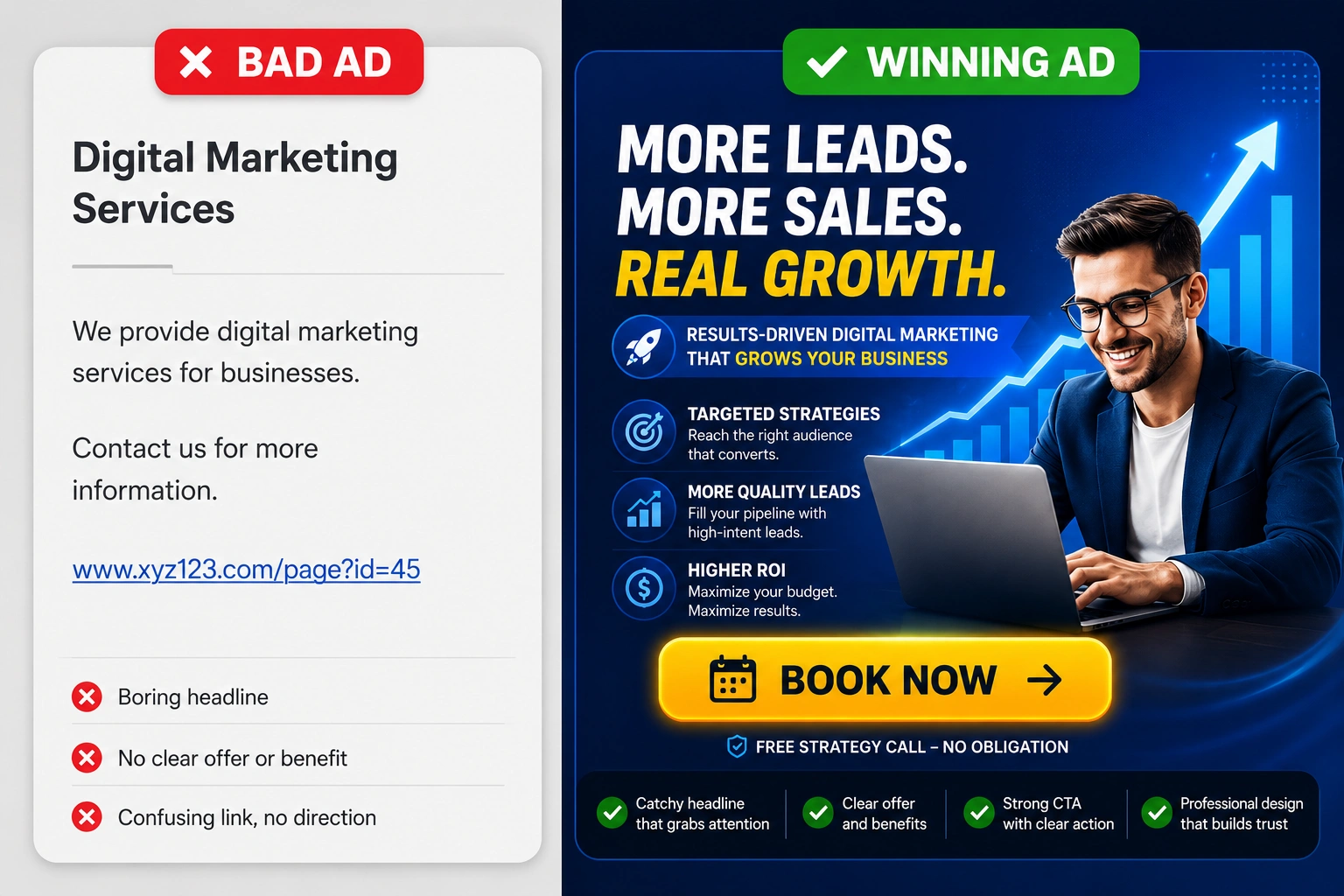
Your headline must stop the scroll. Instead of saying “We offer the best cleaning services,” try “Get Your Home Sparkling Clean in 2 Hours – First Visit 20% Off!” Focus on the benefit, not the feature.
2. The Targeting (The Right Audience)
If you sell high-end jewelry, don’t show your ads to teenagers. Use the targeting tools to narrow down your audience by location, income, interests, and behavior.
Let our team apply these exact strategies to your business — free 30-minute session, no strings attached.
3. The Landing Page (The Destination)
This is where most people fail. If your ad promises a “20% Discount,” but the link takes the user to your home page where they have to search for the discount, they will leave.
Your ad must lead to a specific page that matches the promise of the ad.
Need a page that converts? Check out our Web Development & Design services.
Common Paid Ads Mistakes to Avoid
-
Setting a budget too low: If your competitors are bidding $5 per click and you bid $0.50, your ad will never be seen.
-
Ignoring Negative Keywords: In Google Ads, you can tell Google not to show your ad for certain words. For example, if you provide “Paid Consulting,” add “Free” as a negative keyword so you don’t pay for clicks from people looking for free advice.
-
Not Testing: Never run just one ad. Run three different versions (A/B Testing) to see which one gets more clicks.
Frequently Asked Questions (FAQs)
Q: How much budget do I need to start with Paid Ads?
A: You can start with as little as $5 or $10 a day. However, to get enough data to see what’s working, we usually recommend a slightly higher starting budget for the first month.
Q: Is PPC better than SEO?
A: Neither is “better.” They work together. PPC gives you instant leads today, while SEO builds a foundation for free traffic tomorrow. The best strategy is to use both. Learn more about SEO services here.
Q: How do I know if my ads are working?
A: We track “Conversions.” A conversion is when a user does what you want them to do (e.g., fills out a contact form or makes a purchase). If you spend $100 on ads and make $500 in sales, your ads are working!
Conclusion: Ready to Turn on the Lead Machine?
Paid ads are the fastest way to grow a business, but they require a professional strategy to avoid wasting money. When done correctly, PPC is like a machine: you put money in, and leads come out.
Stop guessing with your marketing budget.
Let the experts handle your campaigns. Contact Jash Marketing today and let’s scale your business to the next level!